Hoop Land
- 4.8
- Rating
- 1.00M
- Installs
- Free
- Price

 Analysis by App-foxy
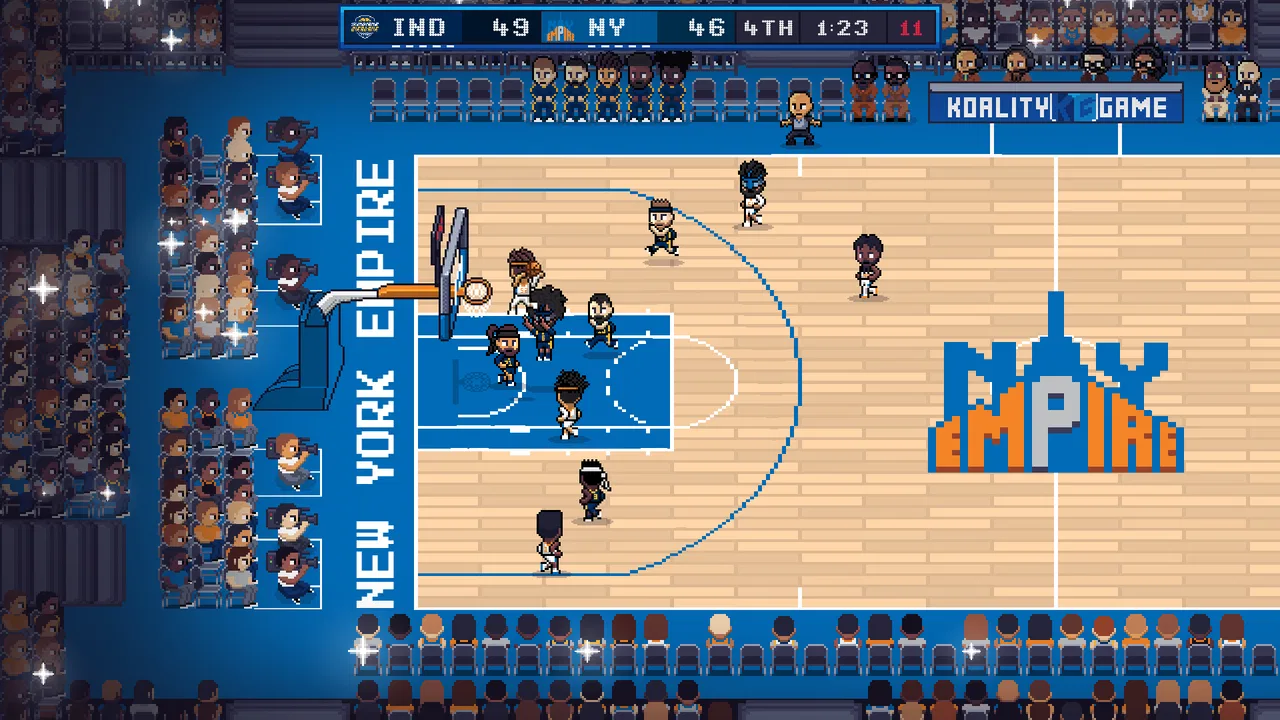
I went into Hoop Land expecting a quick retro basketball game, but I found something closer to a compact basketball management and simulation experience. Its simple visual style makes it approachable, while the decisions behind each game give it more staying power than a basic arcade title. It is the kind of sports game I can play in short sessions, yet still think about later when I want to adjust my approach.
That balance is the main reason I would recommend it to a friend who enjoys basketball but does not want a demanding, realistic console-style simulation. Developed by Koality Game, this free sports game focuses on the feeling of building and guiding a basketball team rather than only controlling individual highlight plays. The retro presentation is not just decoration; it helps keep the interface readable and the pace comfortable.
The game is available to players rated Everyone, and it runs on Android devices using version 6.0 or later. That broad compatibility matters because the experience does not depend on cutting-edge graphics hardware. I tested it with the mindset of someone deciding whether to keep a sports game installed for regular use, not merely launch it once and forget it.
You May Also Like

 Google Keep - Notes and lists
Google Keep’s Quiet Growth Shows the Appeal of Simpler Notes
As mobile work gets busier, Google Keep keeps winning a simple contest: capture a thought quickly, find it later, and get on with the day.

 Blood Strike: 2.5 Anniversary
Blood Strike’s Loadouts Turn Every Drop Into a Tactical Gamble
A close look at Blood Strike’s custom loadouts: how fast access to signature weapons reshapes its battle royale rhythm, rewards preparation, and narrows the gap between fights.

 Pandora - Music & Podcasts
Pandora’s Music Is Easy to Start, but Harder to Recover
Pandora’s strength is its low-effort path from a seed to a station. Its weak spot is how much confidence it asks you to place in connection, setup, and quiet recovery.

 8 Ball Pool
 Is Built on Rivalries, Rematches, and Routine
A close look at the rivalries, rematches, shared routines, and unanswered safety questions that turn a quick pool match into a persistent mobile community.

 Samsung Music
’s Quiet Strength Is Playing What You Already Own
Its reach comes less from spectacle than from dependable access to a personal library. That simplicity is both the app’s strongest retention engine and its ceiling.

 AccuWeather: Weather Radar
AccuWeather Review: A Quick, Clear Forecast for Everyday Decisions
For everyday plans, the best forecast is the one you can understand quickly. AccuWeather makes rain timing, radar, and local conditions easy to act on, with a few trade-offs.
More From Our News Desk



How Hoop Land feels in everyday play
The first thing I noticed was how quickly the game communicates its identity. The pixel-inspired look gives it an old-school sports-game personality, but the appeal comes from the amount of thought placed behind each possession. I was not simply tapping through a match without consequence. Choices about how I wanted the team to play affected the way I approached the game, which made even shorter sessions feel purposeful.
A realistic use case is a short break during the day. I can open the game, handle part of a schedule or play through a manageable stretch, then stop without feeling that I have abandoned a long cinematic sequence. That flexibility suits mobile gaming far better than a title that expects a full uninterrupted sitting. At the same time, the structure gives me a reason to return because the next decision feels connected to what happened previously.
Players who enjoy sports strategy will probably get more from it than players looking only for fast arcade action. The game asks me to care about the broader direction of a team, not just whether I can score on the next possession. That makes the experience feel more deliberate than a typical pick-up-and-play basketball app.
The retro style also lowers the learning barrier. There are fewer visual distractions than in a photorealistic basketball game, so I can focus on what the team is doing and why a result occurred. This is especially useful on a phone screen, where dense interfaces can quickly become tiring. The trade-off is that anyone looking for lifelike players, broadcast presentation, or console-level spectacle will find the presentation intentionally limited.
The strategic layer is the real attraction
What kept me interested was the relationship between short-term results and longer-term decisions. A single loss did not feel like an isolated failure. It encouraged me to reconsider how I was approaching the team and whether my current plan matched the situation. That kind of feedback loop is more satisfying than simply repeating the same match until a better result appears by chance.
My most useful habit was to avoid changing everything after one poor performance. Instead, I treated each game as a clue. If the team struggled, I looked at the broader pattern before making another adjustment. This is a small but important difference between playing casually and getting value from the simulation. The game rewards patience more than frantic menu-hopping.
Another practical tip is to decide what kind of experience you want before starting a session. If I wanted a quick basketball fix, I focused on the immediate game. If I had more time, I paid attention to the team-building side and considered how one decision might affect later progress. Switching between those two mindsets made the game feel less repetitive.
This is also where the title separates itself from many ordinary basketball alternatives. Arcade games usually emphasize direct control, timing, and flashy scoring. Hoop Land is more interested in the identity of a team and the consequences of guiding it. On the other hand, a pure management game may offer deeper spreadsheets and more detailed administration. This sits between those extremes, which is a strength for players who want strategy without turning every session into office work.
What the current version says about its maturity
The current version is 1.09.61, while the game was released on October 24, 2023. That combination suggests a product that has had time to move beyond its initial launch state. I would not describe it as something that feels frozen at release. The overall package feels shaped by continued attention, even though the experience remains deliberately compact and retro rather than trying to become a huge modern sports production.
For an existing player, the practical takeaway is that the current build is the one to judge rather than an early impression from launch. If someone tried it near release and found the concept interesting but unfinished in feel, it is worth checking the present version before making a final decision. I would still keep expectations realistic: continued development does not automatically turn a focused mobile simulation into a full console replacement.
The version number is useful context, but I would not treat it as a promise about future additions. I prefer to separate what is playable now from what I might hope to see later. At present, the value comes from the existing basketball loop, its retro accessibility, and the way it blends team decisions with match outcomes.
That distinction matters for new users too. I would install it because I like the current concept, not because I am waiting for a particular future feature. If later updates broaden the experience, that is a bonus. A game should already earn its place on the phone before expectations about upcoming changes enter the picture.
Who will enjoy it most
I think the best audience is someone who likes basketball management but wants a friendlier entry point. You do not need to understand every tactical detail before starting. The game gives you room to learn by playing, and the retro design makes experimentation feel less intimidating than it can in more elaborate sports simulations.
It also suits players who enjoy replaying a season or building a team gradually. The appeal is not limited to one dramatic match. It comes from seeing whether your decisions create a team that performs more consistently over time. That longer view gives the game a useful reason to stay installed after the novelty of the first session disappears.
It is a good choice for mobile players who dislike aggressive visual clutter. The interface feels focused on the sport rather than on trying to imitate a television broadcast. I can play without needing a large screen or a long tutorial before understanding the basic purpose of a session.
However, I would skip it if your ideal basketball game is built around direct, real-time control of every star player. Someone who wants to perform dribble combinations, chase spectacular dunks, or compete primarily through reflexes may find the strategic emphasis too slow. In that situation, an arcade basketball game would be a better match.
I would also hesitate to recommend it to anyone who wants a highly detailed professional management simulator. Hoop Land offers a more approachable middle ground, but that accessibility means it may not satisfy players who want an enormous database, complex financial modeling, or a presentation packed with real-world detail. Its strength is focus, and focus always involves leaving some depth or spectacle aside.
Small decisions that improve the experience
One mistake I made early was treating every match as a test of whether the team was good or bad. A better approach is to use matches as experiments. I changed one part of my approach at a time, then watched whether the next result supported that change. This made the simulation easier to understand and reduced the temptation to blame random outcomes.
I also found it helpful to play in clusters rather than constantly opening and closing the game after a single action. A short sequence gives more context than one isolated result. When I returned later, I could remember what I had been trying to accomplish and judge whether the plan was working. That workflow makes the game feel more like managing a project than consuming a disposable match.
Another trade-off is the value of patience. If you prefer immediate rewards, the slower strategic rhythm may initially feel less exciting. I enjoyed it more once I stopped expecting every session to deliver a spectacular moment. The satisfaction comes from recognizing a pattern, making a measured change, and seeing the team respond.
The retro graphics can also be used to your advantage. Because they are visually simple, I found it easier to focus on the logic of the game instead of being distracted by presentation. But I would not recommend judging the title from screenshots alone if you normally prefer modern sports visuals. The style is central to the experience, not a temporary placeholder for something more realistic.
Free access and the purchase decision
The game is free to install, which makes trying its central idea straightforward. There are in-app purchases priced at $4.99 per item, so I would approach the optional spending carefully rather than assuming that paying is necessary to understand the game. My recommendation is to play long enough to decide whether the strategic loop itself appeals to you before buying anything.
That advice is especially relevant because the game’s main question is personal: do you enjoy guiding a basketball team through decisions, or do you mainly want hands-on action? No purchase can change that basic fit. If the management side clicks, the free entry point gives you a sensible way to explore it. If it does not, spending more will not solve the underlying mismatch.
I also appreciate that the price structure is easy to understand at a glance. A player can treat the game as a free sports experience first and consider individual purchases only after deciding whether the extra value is worthwhile. I would avoid paying out of frustration after a difficult result; a poor match is more likely to reflect a strategy that needs reconsideration than a reason to spend immediately.
How it compares with other basketball games
Compared with arcade basketball titles, Hoop Land is less about reaction speed and more about reading the situation. It does not compete on the same terms as a game built around instant scoring, dramatic animations, or direct player skill. Instead, it gives me a reason to think between matches and care about the direction of the team.
Compared with serious management simulators, it is easier to approach and less intimidating. I do not need to treat every session like a detailed administrative task. That makes it a better fit for a phone, particularly when I have only a few minutes. The compromise is that highly dedicated simulation fans may want more layers than this focused design provides.
Compared with a modern licensed basketball game, it offers a very different kind of authenticity. It does not try to reproduce the television experience. Its authenticity comes from the feeling of making basketball decisions inside a deliberately old-fashioned game framework. If you value real teams, realistic arenas, and star likenesses, another option will probably suit you better. If you value systems and replayability over spectacle, this game has a clearer advantage.
The broad audience response supports its appeal: it holds a 4.8 average from around 13 thousand ratings, with roughly 1.8 thousand written reviews and over a million installs. Those figures do not replace personal taste, but they do show that the focused approach has connected with a substantial mobile audience.
Where the experience still has limits
The biggest limitation is also the clearest design choice: this is not trying to be every kind of basketball game at once. Players wanting a deep professional ecosystem, highly cinematic matches, or constant action may feel that the experience is too restrained. I would rather see that limitation honestly than pretend the retro format covers every preference.
There is also a learning curve that comes from understanding how much weight to give each decision. The game is approachable, but approachable does not mean mindless. New players may need a few sessions to understand which choices deserve attention and which results should simply be accepted as part of the process. I found that rewarding, though someone looking for instant clarity may become impatient.
The free-to-play structure deserves the same balanced view. The entry cost is low, but the presence of individual purchases means I would still set a personal spending boundary. Players who prefer a one-time purchase with every feature permanently included may feel more comfortable with a premium alternative, even if that alternative lacks Hoop Land’s specific blend of retro presentation and basketball strategy.
Finally, the game’s appeal depends heavily on replaying the same core idea from different angles. If you need constant new modes or a story that keeps changing, the loop may eventually feel narrow. I see that as a reason to choose it selectively, not as a flaw that makes it unworthy. It works best when I want a dependable basketball sandbox rather than an endless stream of content.
What existing and new players should watch next
For current users, I would watch how future updates affect the balance between accessibility and depth. The best direction would be to add meaningful choices without making the game cumbersome. More complexity is not automatically better; the charm comes from being able to understand the consequences of a decision while still feeling that there is room to improve.
For new users, I would pay attention to whether the first few sessions give you enough confidence to form your own strategy. My advice is to resist judging the game after one result. Give yourself time to see the connection between decisions and outcomes, then decide whether that process is enjoyable.
I would also keep an eye on how the current version feels on your particular phone. The minimum operating-system requirement is Android 6.0, which makes the compatibility target broad, but individual comfort still depends on screen size and how you like to interact with mobile menus. A larger display can make strategic reading more pleasant, while a smaller phone may be better for quick sessions.
Most importantly, I would not confuse popularity with universal suitability. The game’s rating, review volume, and install base show strong interest, but the right question is whether you want a retro basketball simulation rather than a traditional action game. That distinction will determine your experience more than any headline number.
My recommendation after spending time with it
I recommend Hoop Land to players who want basketball decisions, team-building satisfaction, and a retro style that keeps the game readable on a phone. Its free starting point makes it easy to test, and the current version feels like a mature place to evaluate the concept rather than merely a first draft. I especially enjoyed it when I approached each session with a small plan instead of chasing instant wins.
I would not recommend it as a universal replacement for arcade basketball or a full-scale management simulator. Those games serve different moods, and this one is strongest when you want a thoughtful middle ground. The limitations are real, but they are closely tied to the focused design rather than signs that the game does not know what it wants to be.
For me, the lasting appeal is the combination of low visual friction and meaningful basketball choices. I can pick it up during a short break, return later to continue a longer plan, and still feel that my decisions matter. The best reason to try it is not the retro look alone, but the way that look supports a calm, replayable basketball strategy experience.
With an Everyone age rating, free access, support for Android 6.0 and later, and a strong response from mobile players, it is an easy recommendation for the right audience. Just go in expecting a focused simulation rather than a flashy licensed showcase. If that sounds like the kind of basketball game you have been missing, Koality Game’s approach is well worth your time.
FAQs for Hoop Land
01What is Hoop Land and what kind of gameplay does it offer?
Hoop Land is a dynamic basketball simulation game available on both Android and iOS platforms. It offers a realistic basketball experience with smooth controls, customizable teams, and various game modes. Players can engage in quick matches, tournaments, or even a career mode, making it suitable for both casual players and basketball enthusiasts.
02Is Hoop Land free to play, and are there in-app purchases?
Hoop Land is free to download and play, providing users with access to a variety of gameplay features without charge. However, it does include in-app purchases that allow players to enhance their gaming experience. These purchases can range from cosmetic upgrades to boosts that affect gameplay, providing an edge in competitive modes.
03What are the system requirements for Hoop Land on Android and iOS?
For Android devices, Hoop Land requires at least Android 5.0 and 2GB of RAM for optimal performance. On iOS, the app is compatible with iOS 10.0 or later, and it's recommended to have at least an iPhone 6 or newer. Ensuring your device meets these specifications will help provide a smooth gaming experience.
04Does Hoop Land offer multiplayer features and online gameplay?
Yes, Hoop Land offers robust multiplayer features, allowing players to compete against friends or other players worldwide. The game includes both local multiplayer options via Wi-Fi and online matchmaking. These features enhance the competitive aspect of the game, providing endless replayability as you climb the global leaderboards.
05How frequently is Hoop Land updated, and what kind of support can players expect?
Hoop Land receives regular updates that include new features, gameplay improvements, and bug fixes. The developers are active in maintaining the game, often incorporating player feedback into updates. Players can expect ongoing support through dedicated customer service channels and community forums where they can report issues or suggest improvements.
Pros
- Engaging gameplay with intuitive controls.
- Vibrant graphics enhance user experience.
- Wide variety of levels keep it interesting.
- Regular updates with new features.
- Supports offline play for convenience.
Cons
- In-app purchases can be pricey.
- Occasional ads disrupt gameplay.
- Some levels feel repetitive.
- Requires frequent updates for stability.
- Limited customization options for characters.

Hoop Land
Gallery